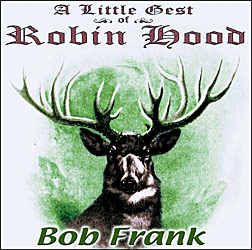
I first came across the Lytell Geste of Robyn Hode back in 1973, in James P. Childs The English and Scottish Popular Ballads. I was trying to write a story about Robin Hood, and I figured I would check out some of the original sources. This old ballad, originally printed by Wynkyn de Worde in the1500s, was one of the earliest ones, so I started with it. Only problem was, it was written in late Middle English. I had this weird idea that I could just look at these old words, and their meanings would make themselves clear to me. I started in on it, and before I’d gone through the first verse, I was thumbing around in the glossary looking for definitions. But my efforts paid off. As I got deeper and deeper into this obscure beauty, I became entranced by it. This stuff was pure gold. I kept asking myself, who wrote this thing? Where did it come from? Why isn’t it in everybody’s school book? Why hasn’t anybody ever put this thing into modern English? Could it be that nobody knows it exists? I just figured, well, maybe nobody thinks it’s good enough. Or — maybe nobody has taken the time to read it and find out just how good it really is. I didn’t know the answer to any of these questions. All I knew was, I was infatuated with this old poem. I wanted to be able to read it whenever I felt like it. I wanted to be able to read it to my children. And I didn’t want to have to look up every other word when I did it.
Im a songwriter. Thats what I do. Ive been writing songs all my life. Hell, I write em in my sleep. Back in the day, I memorized every folk song that came down the pike. I could sing them all for you. And this one, this Lytell Geste of Robyn Hode, looked like the grand daddy of them all. All I had to do was re-spell it. But I soon found out, this wouldn’t work because some of the words have changed beyond recognition. In order to keep the rhythm and rhyme of the old ballad stanza, I was forced to come up with some new words here and there. In some places, some new lines. And in other places, a whole new verse. But this was right down my alley. This was a challenge that tasted like candy. And because nobody had ever put it into modern English before me — at least not to my knowledge — I felt like I could do whatever I wanted with it and nobody would know the difference. It was almost like I was creating a whole new song from scratch. But I didn’t really want to turn it into anything other than what it already was. The language was so pure, so simple, so strong. It was perfect, just the way it stood. I just wanted to fix it so anybody who walked in right off the street would be able to read it.
Then it sat in a desk drawer for thirty years. I didn't know what to do with it. Who would publish it? Could I perform it somewhere? Where? How? Would I speak it? Sing it? It was too long to put a tune to. I just let it lie there. Every few years or so, I would take it out, dust it off, and read it out loud to my kids and my wife. Or just silently to myself. The beauty of it never wore off. Surely, the world should hear this thing. Maybe somebody would like it. But how to go about it? I didn't have a clue.
Then, late in 2001, I saw Tom Ohlgren’s book, Medieval Outlaws, and there it was, my favorite poem in the English language, translated into prose. Hey, I thought. Maybe there’s an audience for this thing after all. I quickly had my version of it printed up and sent it to Tom, found his phone number and called him up. He was the picture of helpfulness. Straightened me out on several places in the text where I had read it wrong, turned me on to this Robin Hood group, a bunch of scholars, artists, writers, actors, etc., who were having a conference in a few months up in Canada, and helped get me on the program there, so I could actually do a performance of the Gest for these folks. Of course, this meant I would have to memorize it, or part of it, enough to give a performance, and come up with some sort of something or other to play on the guitar as I spoke the words. As it turned out, I went up there and played the first two fits for them. They loved it. They wanted to hear the whole thing. Little did they know, I didn’t have the whole thing. I was making it up as I went along. But I told them I would come home and make a cd of it, and they could buy that and listen to the whole thing. They said, go ahead. So I did.
I came home and memorized the whole Gest, all 456 verses of it, while I was throwing together some chords to play on the guitar that would complement the lyrics, and at the same time, trying to learn how to use this digital recording gear and get the whole thing down on a cd, or a cd-r, whatever. I recorded right here at home. It only took about three months “real time,” but I think it probably took about ten years off the end of my life. We’ll see... (Just think. If I die when I’m eighty-nine, you’ll know I would’ve lived to be ninety-nine, if I hadn’t stopped to do this Little Gest.)
Nobody knows who actually wrote this thing. Who made it up. It probably never was written until one of those printers got ahold of it in the 1500’s. Up until then, it was just sung. Or spoken. Or performed. Nobody knows about that part either. Nobody knows who did it, or for whom, or how, or where or when — or why. Theres no existing music for it. The way I do it is just the way it came out, while I was sitting out there under a buckeye tree in the back yard, looking down at the creek. I’ve had a couple of authorities on the subject tell me that the way I’m doing it here is probably the way it was done back in the 1400’s, the way it must have been done, the way all those old minstrels did it, the way Homer did it.
Earlier, I said this was the oldest Robin Hood song in the book. Well, it’s also the longest Robin Hood song in the book. According to how we classify music today, I guess you could call it a talking blues. If so, it’s the longest talking blues in the world. But whatever you call it, at last, it’s just a song. And the beauty of it is, you don’t have to be able to carry a tune to sing it.
Order a copy of A Little Gest of Robin Hood today and see — or hear — for yourself just what a wonderful piece of obscure literature this song really is. (It only stands to reason it would be obscure. Otherwise, how would Bob Frank ever have been attracted to it in the first place?)
|
|
|
The materials on this website may be copied for non-commercial, personal use only. ©2005 Bob Frank. |
|
If you find any errors please contact the webmaster. Last modified 7/14/05 |