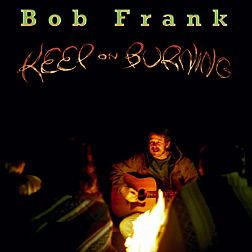
Keep On Burning

©2002 Painted Arrow, BMI

Somewhere else on this website we mention Robert Gordon, the author of that milestone book about Memphis music, It Came from Memphis. Well, here is what Mr. Gordon has to say about Bob Frank and Keep on Burning:

This is, after all, where this rock and roll mess began: a human being and a guitar. Bob Frank stands naked on stage, baring his soul in a coffee house. Except for the fashion on the clothes (he's not really naked), it could be any year, any time, any place.

In the early part of the 1960s, they called it a hootenanny. Jim Dickinson, whose career was moving in a decidedly theatrical direction, appreciated the power of folk music (he’d first retired from rock and roll in 1959). Dickinson had helped found the Market Theater in Memphis, a jook of a performance space, and was way off into the Sunday afternoon musical free-for-alls.

Dickinson didn’t know Bob Frank from Wild Bill Jones when Frank stepped to the stage with his guitar in hand. Bob Frank sang “With Sabers in Our Hands” and Dickinson damn sure set to finding out who he was. Frank had been thrown out of Vanderbilt University for playing his acoustic guitar too loud. A friendship was born.

Bob got to make a record for Vanguard way back when, Dickinson cut Frank’s “Wild Bill Jones” on his legendary 1972 solo album, and Bob moved out west, finding his way mostly out of the music biz, though he never strayed too far from the guitar.

Bob Frank’s songs are the proscenium between the personal and the universal. I was a kid in Memphis when the Cotton Carnival used to be on the riverfront. I immediately conjured that image, and all the conflicted emotions, the excitement and the emptiness that follows, when I listened to "Since the Midway Came to Town" on this album. I believe anyone would feel the same thing, hearing lyrics about a midway, fireworks, and the “good gal” that “packed her grip and gone across the Mississipp.” Frank is unflinching, letting it all wash so impersonally down the mighty river.

This disc includes a trucker's song (I'll never pass a Peterbilt on the highway without thinking of "Old Truckers"), a hippie-era ballad ("Journey to Myself"), even a gospel song about a different kind of revelation (Vanguard made him censor it; it’s here in its original form). But most fascinating is the Civil War ballad, "With Sabers in Our Hands," which sounds like it came marauding off an 1864 battlefield letter writ in blood. But Bob Frank wrote that one too.

I just went back to check a song lyric and was shocked to hear the other instruments on the track. I'd remembered the performance as just Frank and his guitar. Now that's perfect accompaniment (provided by the Dickinson family); it fleshes out the solo artist's feel without diluting his strength.

It's been three decades since Bob Frank's first album, the obscure LP on Vanguard (I'd like to buy yours if it’s just collecting dust). This collection mixes older material with the new, and there's no distinction. He locked into his songwriting mode back then, and it's worked ever since; he's had no reason to get a new Peterbilt. He's been this good for that long. Listen to how the words are phrased, how the lines are broken and assembled to the performance.

These songs, this record, Bob Frank: time just ain't a factor.

———<>———

In the July 20, 2002, issue of Billboard, Chris Morris has an article about Bob Frank and this new CD, Keep on Burning. Chris, who is the senior writer at Billboard, says this album is “absolutely wonderful.” He also says it is a “richly sung… diverse, superb set of songs.” He also spends the first half of this article talking about Jim Dickinson. That’s because Jim produced this album. Here’s a little background on that.

Jim Dickinson and Bob Frank have known each other ever since the early sixties — til Bob finally disappeared in the fog out in San Francisco. They used to play in coffee houses that sprung up all over Memphis back in the folk era. Jim was always singing the blues, and Bob was trying to figure out why anybody ever thought cigarettes and coffee actually tasted good together.

Bob used to sing some songs that he wrote back then, like “Since the Midway Came to Town” and “With Sabers in Our Hands,” and Jim always said he wanted to record these songs at some point. He actually did record “Sabers” with Jerry McGill at a session at Sam Phillips studio in Memphis back in ’74, or thereabouts. Jim says in the seventies, all linear time disappeared, so it’s tough to nail down any dates… (Robert Gordon tells about this insane session in his book, It Came from Memphis.)… but, the point is, the thing I wanted to tell you, for thirty years Jim’s been wanting to get Bob in a studio and record some of these songs, and in the spring of 2001, he finally did it. He got Bob in a barn somewhere down in north Mississippi and put some recording equipment in there and told Bob to start singing. Then he got Kevin Houston to run the gear, and he got his sons, Luther and Cody of the North Mississippi Allstars to get in there and play along with Bob so he wouldn’t feel too lonesome, and then, all of a sudden, Bob said, wait a minute. Where’s Mike Dunbar? So they had to get Mike to come down from Nashville with his standup bass, and then Jim got on the phone and called up all these other musicians from all over Memphis and north Mississippi — Jimbo Mathus, Jim Spake, “T-Bone” Tommy Burroughs, Sid Selvidge, Jimmy Crosthwait, Jimmy Davis, Pete Matthews, Andy Cohen, John Whitmore — and they went at it. They kept Bob in that barn for a week, and if it hadn’t been for Mary Dickinson’s home cooked meals, he would have starved to death.

A little bit about the songs. “With Sabers in Our Hands” was written by Bob when he was in high school, and “Since the Midway Came to Town,” shortly thereafter. We tell about “Sabers” elsewhere on this site. “Midway” was written when Bob was hanging out in Memphis in a garage apartment over near the Zoo in Overton Park. Bob and Jim Cole and Randy Hayes and Alex Myatt would sit around there smoking cigarettes and kissing girls and drinking quarts of Canadian Ace and listening to old records of Jimmie Rodgers, the “yodeling brakeman.” This is what inspired Bob to write this song about a poor boy in Memphis whose girl ran off to Arkansas just at the same time that the midway came to town. It was just a joke of a song at the time, but the joke was on Bob, because a few years later, when Bob got back from Nam, his girl really did run off to Arkansas… only, she didn’t run off to Mountain View. She ran off to Stuttgart. Jim always wanted to record these two songs.

And when Bob was in Nashville, writing for Tree Publishing Company, he came up with this song about a guy out on the prairie when night was coming on, and he didn’t have any place to sleep, so he slept out on the ground, down in a ditch next to some dried up cow bones. When Jim heard that song, he knew he would have to record it some day. He tried to get Sid Selvidge to record it, but Sid said it was too weird for him.

The rest of the songs on this album were suggested by Bob, but the reason he suggested them in the first place was because he figured Jim would like them. They’re all sort of unusual songs. “Journey to Myself” is a cowboy song without any cowboys in it. Instead, it’s got a different cast of characters. The 7 Deadly Sins. Bob’s version of the magnificent seven. But people who are more into Dungeons and Dragons than westerns don’t see this as a cowboy song, but as a story set in the Middle Ages. The reason this is possible, is because there’s no mention of any specific sort of weapons or costumes. It’s just the bare bones of a story. It could have happened anywhere, at anytime.

Another song Jim had to put on here is “Judas Iscariot.” This song was on the Vanguard album, but not this version of it. This version on Keep on Burning is the original one. This song came to Bob in a dream. Literally. Word for word, just like you hear it on this album is how it appeared to Bob in a dream. With this same tune, to these same chords. Bob had been out walking around drunk in the rain one Sunday afternoon in Nashville, and he wandered into this little chapel called The Upper Room. He staggered up the stairs to a little room that had a reproduction of Leonardo’s Last Supper on the wall, and he stood there swaying around and looking at it for one of those eternities that you sometimes find crammed into a few minutes. There was a little bench there, so he took a seat and studied that picture. He looked at all the faces of all the disciples and tried to figure out which one was Judas. He got into their clothes, their robes. He sat at the table with ‘em. He ate the bread and drank the wine. They rubbed elbows and swapped jokes. He wondered why Judas would do what he did, betray Jesus like that. He couldn’t understand it. He thought it was all wrong. Somebody had probably told the story wrong in the first place, and people had been repeating it that way ever since. He wanted to know what the real story was. He wanted to know the truth.

He felt like he and Judas were two of a kind. Like they might have hit it off back in the day. He felt like Judas got a bad deal. Somebody had to do it. If it hadn’t have been for Judas, it never would have happened. Judas was the one who was willing to take all the shit — for eternity — so the world could have Jesus. Who was the real hero here?

Bob was drunk. He went on home to his one-room apartment on 17th Avenue South and fell across his swaybacked bed and went to sleep. Passed out. Then he had this dream. He saw these two old black men down in south Memphis sitting out in the back yard under a catalpa tree, playing checkers on a sawed-off tree stump. Then he heard this song. Then he woke up and realized it was all a dream. So he grabbed a pencil and some paper and wrote it all down, word for word, just like it was in the dream.

So if you find anything irreverent or sacrilegious about this song, it’s not meant to be that way. It’s just the way Jesus appeared to a drunk songwriter back in 1969, in Nashville.

“Headlights” is a song Bob wrote for his wife. He’s written a lot of songs for her, but this is one of the peppiest.

“Break My Heart Again” is an old story, but the song was only written a few years ago. Jim put this one on the album because Bobby Fisher said it was a hit song, and Jim learned a long time ago that when it comes to picking hit songs, Bobby Fisher has an inside link.

So this new CD has some of Bob’s older songs on it, but it also has some of his newer ones. It’s a great mix of stories, all told as only Bob Frank can tell ‘em. But this time with the added touch of a master producer. Jim knows just how to “showcase” a song. He does it without any fanfare, without any fireworks, without any foofaraw, without any bullshit. He gets inside the song and lets it tell him what it needs. There isn’t any other producer on the planet that can do this as smoothly and invisibly as Jim Dickinson. If all this sounds too good to be true, buy the CD and see for yourself.

Musicians can make or break a song. In this case, they made it. They made every one of these ten songs sound like they were meant to sound. Some of ‘em are sparse and bare as an Arizona desert, some of ‘em are as rich and lush as a Mississippi bottom, and all of them are as organic and natural as sunlight on a water moccassin.

Actually, these boys had two more songs on that tape, ready to go into this album, but one of the machines went haywire and ate ‘em up. Such is life. Maybe they’ll put ‘em on the next one.

———><———


The materials on this website may be copied for non-commercial, personal use only. ©2005 Bob Frank.
If you find any errors please contact the webmaster. Last modified 7/14/05